There's a moment you may know well.
Something lands — a word, a memory, a silence — and a feeling rises that's bigger than the moment itself.
Every old habit says make it stop. Push through it. Distract from it. Or reach for the more graceful-sounding version: let it go.
But some feelings aren't ready to be released. They're ready to be met.
This practice offers a gentler path — not away from the feeling, but into it, held with enough steadiness that you don't have to brace or disappear. Just to stay. Just to witness.
What you'll practice:
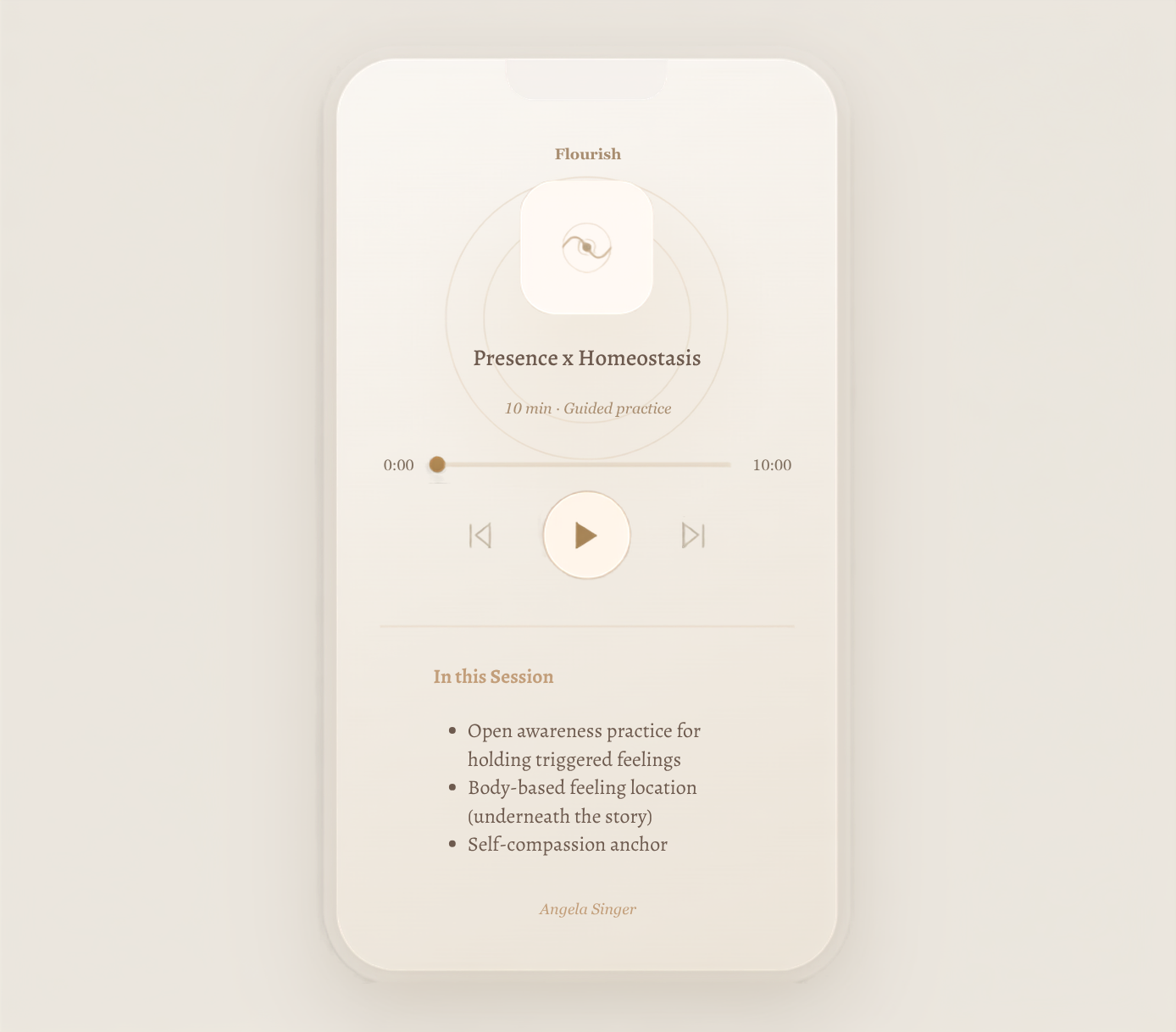
Open awareness practice for holding triggered feelings
Body-based feeling location — going underneath the story to where the feeling actually lives
A self-compassion anchor to meet yourself with warmth instead of judgment
The neuroscience of staying present:
When a feeling gets triggered, your amygdala — the brain's alarm system — activates faster than your thinking mind can catch up. This is why big feelings can feel like they're happening to you rather than with you.
Two things help regulate that response. The first is simply naming what you feel — research on affect labeling has shown that putting words to an emotion measurably calms amygdala activity, giving your prefrontal cortex, the part of the brain responsible for reasoning and regulation, more room to come back online.
The second is staying inside your window of tolerance — the nervous system's term for the range in which you can feel something intensely and still remain present, grounded, and able to think clearly. Practices that gently widen this window, rather than avoid its edges, are associated with greater emotional resilience over time.
And this is where neuroplasticity comes in. Every time you choose to stay with a feeling instead of suppressing or spiraling into it, you're reinforcing a different neural pathway — one built on presence instead of avoidance. Neurons that fire together wire together. The more you practice witnessing instead of reacting, the more naturally your nervous system defaults to steadiness the next time something triggers you.
This isn't about willpower. It's about repetition, and about building a body and brain that trust themselves to hold difficulty without falling apart.
Who this is for:
Anyone ready to build a nervous system that can hold more — gently, and with practice.